Procurement brief
Buy a First Aid Kit That Leaves Room for Medications
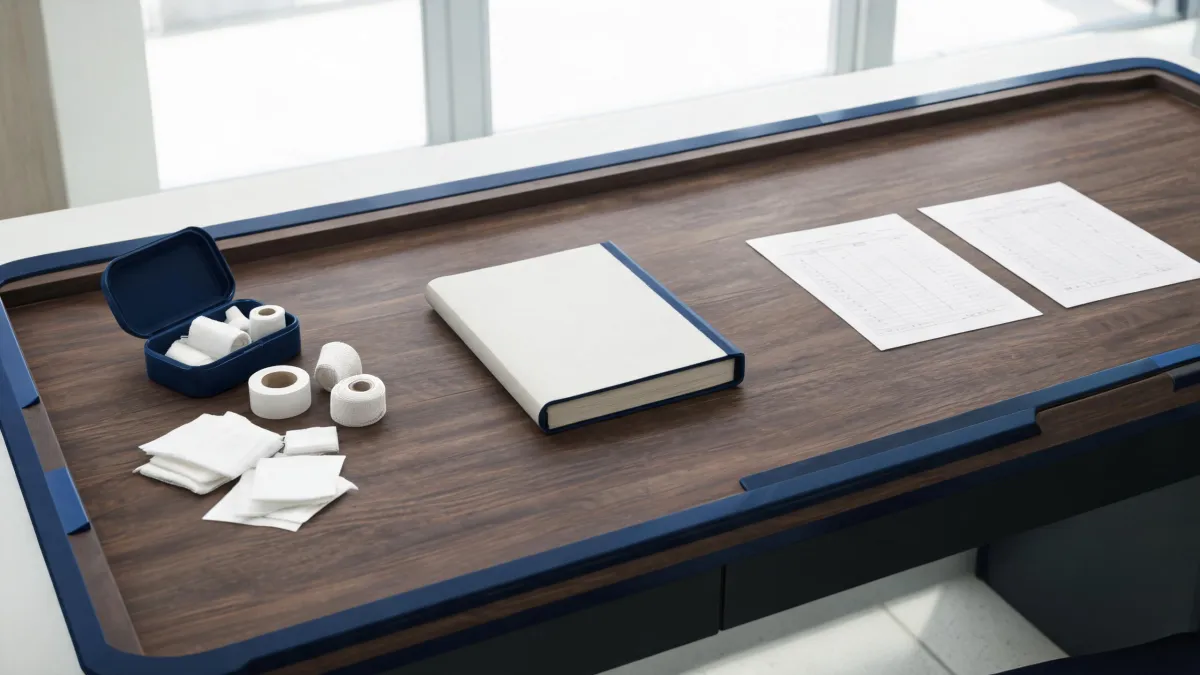
Two kits sit in the same hall closet. Open the first and there is slack: a corner wide enough for a pill bottle, a flat sleeve inside the lid where a card of phone numbers stays visible without unpacking anything. Open the second and every elastic loop is already spoken for, the lid is molded around a fixed layout, and there is nowhere to put a card that will not slide out the next time the case is carried. Both were sold as complete kits. Only one can be finished by the household that owns it.
Red Cross guidance on what a kit should hold lists personal medications, emergency phone numbers, and other items your health-care provider may suggest, alongside the supplies the kit is sold with. None of those three can be packed at the factory, because none of them are the same for two households. The question at checkout is therefore not how long the contents list runs but whether the case still has unassigned room for the items only you can put in.
A Full Kit Can Still Be the Wrong Kit
A kit with a short contents list and a kit with a long one behave the same on the night you need one if the shorter list leaves a compartment empty for your medication container and the longer one does not. The factory fills what it can sell to anyone. It cannot fill what only your household knows, and it rarely leaves a labeled place for it either. Judge the two kits by the space that has no job yet.
The obvious objection is that more items can only help, since nothing packed inside is wasted. Up to a point that is true, and then it stops being true, because the objection measures quantity when the constraint is layout. A case that has no free compartment forces a choice on the owner: carry the medication container inside the kit, or leave the container where it lives now. In many homes the container stays in the drawer, and the kit you paid for is the one missing the thing it was supposed to hold. The contents list tells you what arrived; the empty compartment tells you what the kit can still become.
Three Checks in Order Before You Pay
Before you compare contents or price, run three checks in this order, because the second and third are wasted effort if the first fails.
First, measure the unassigned capacity against the container your medication actually comes in, not against a guess about how big a pill bottle is. A space that fits nothing you own is decoration. Second, look for a slot, sleeve, or flat pocket where a written emergency-number card can sit and be read without emptying the case; paper loose at the bottom survives about one car trip. Third, scan what is already packed and ask whether it has left room for the additions your provider has suggested.
Item count and price come after all three checks, not before. The Red Cross wording is category-level guidance rather than a specification for any particular kit on the shelf, so treat it as the list of things to check, not a claim that a given product satisfies it. The common mistake is starting with the item count because it is the most prominent number on the box. The cost of that order is a kit that arrives full, stays full, and never holds the one thing your household needed it to hold. Start with the empty space, then work outward.
One Kit at Home Does Not Cover the Car
The same guidance points at three locations rather than one: keep a kit in your home and in your car, and carry one with you or know where you can find one. Treat those as three separate purchases with three separate jobs, not one product ordered in three sizes or one big kit split between places.
A home kit that gets raided for the car is how both end up half-stocked, and the failure is quiet: nobody notices the missing item until the moment it is needed, which is the worst possible time to discover it. Each location you add carries its own restocking and checking burden, so let the number of kits follow the number of places you genuinely spend time. If the car is not part of your daily routine and you know where a kit lives at work, the carry-or-know-where option may be the honest answer rather than a third box. The mistake is buying for an imagined set of activities instead of the actual week, because a kit that lives in a closet you never open is a kit you will not check.
For the car, space is the constraint that decides the purchase. A case that fits under the seat and still swallows a medication container beats a better-stocked case that gets left in the garage because it does not fit. Whether a given medication can be kept in a car at all is a question for the prescriber or pharmacist rather than for a buying guide; what this check settles is only whether the case has room.
Pick the Case You Can Still Add To
The practical recommendation is a soft pouch or a case with slack and one flat sleeve, and the exclusions matter as much as the pick. Rule out the molded hard case whose compartments are all pre-assigned, because a fixed layout is a decision made by someone who has never met your medication container. Rule out the oversized kit that is technically roomy but too bulky to keep where your day actually happens; storage you avoid is storage you do not use. Buy a case with no slack and you'll end up buying twice.
Suppose one person in the household takes a daily prescription and needs that container inside the kit rather than in a bathroom cabinet. That is a hypothetical, and it is also the ordinary case. Under that condition the deciding measurement is whether the container drops into the pouch with the zipper still able to close and the card still readable.
A skeptic would say a hard case protects the contents better, and it does, for the contents that are inside it. Protection does not extend to the container sitting in a drawer three rooms away. That spare inch is the whole point: the soft case that takes your container protects more of your actual kit than the rigid one that refuses it.
The Emergency Number Card Nobody Updates
Emergency numbers kept only in a phone are a single point of failure, and the failure mode is specific: a dead battery, a locked screen, a handset that has gone into a puddle with the person who needs it. A paper card inside the kit keeps the numbers where the kit is, which is where the situation is. The purchase question is whether the case gives that card a fixed place rather than leaving it to float.
The card also expires in ways nobody notices. Household events are the trigger to rewrite it: a move, a change of provider, a change of coverage, a child starting a new school. Write it the day the kit arrives, date it, and treat a stale card as a missing item, because a number that rings the wrong office costs minutes at the exact moment minutes matter.
Before you pay, take the medication container you actually use and a written card of your current numbers, hold them in your hand, and put them into the space of the kit you are considering. If they do not fit, do not buy it. Every other shortfall in a kit can be fixed later with a trip to the pharmacy; the amount of unassigned room is set by the design, and nothing you buy afterward adds it.

Jane Smith
I’m Jane Smith, a senior content writer with over 15 years of experience in the packaging and printing industry. I specialize in writing about the latest trends, technologies, and best practices in packaging design, sustainability, and printing techniques. My goal is to help businesses understand complex printing processes and design solutions that enhance both product packaging and brand visibility.
Leave a reply